Articles
Build logs, concept explorations, and technical writing. Entity memory, governed AI, emerging patterns from the infrastructure layer.
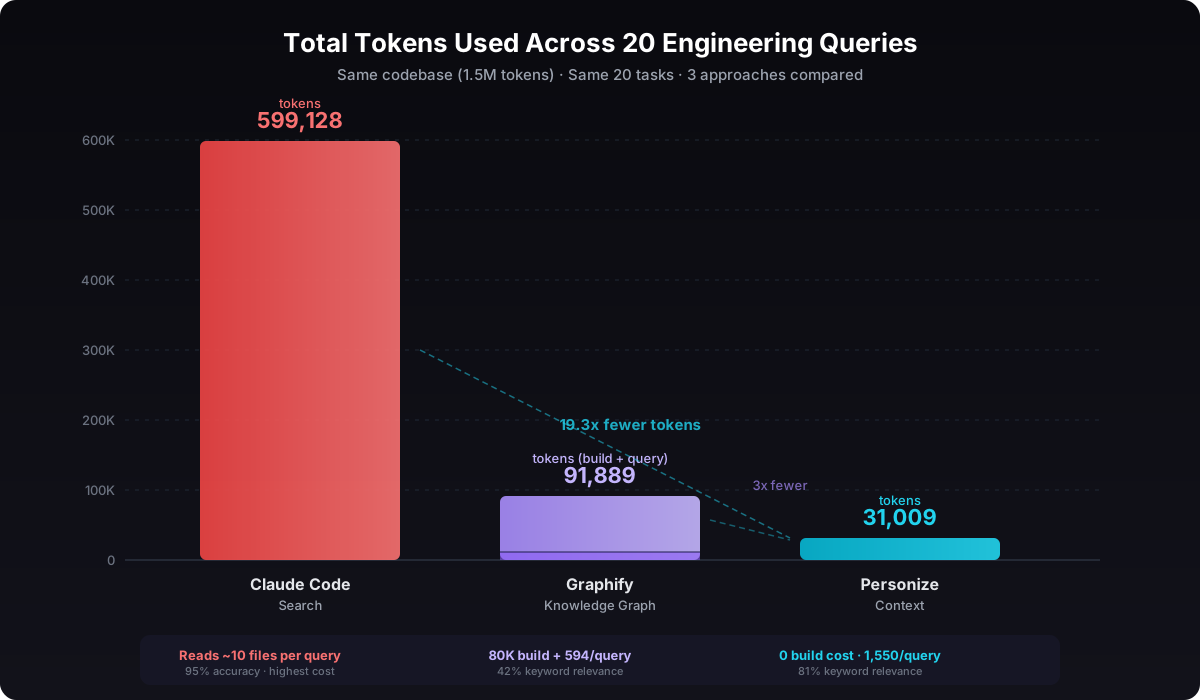
57x Compression for AI Coding Agents
1.5M tokens of source code, compressed to 27K of curated context. Benchmarked against Graphify and raw grep on 20 real engineering tasks; the curated approach won on total workflow cost.
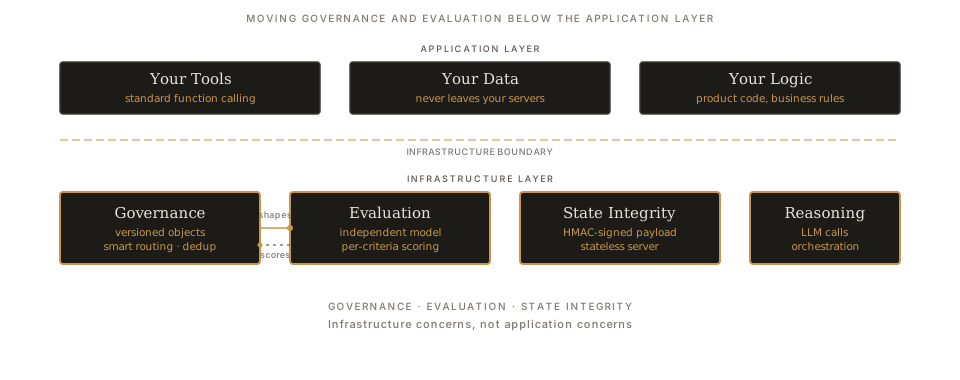
Moving Governance and Evaluation Below the Application Layer
Governance lives in system prompts. Evaluation lives in separate pipelines. State lives in session stores. We moved all three into the infrastructure layer of an AI API. Here is the architecture and what it changes.
We Replaced messages[] With steps[] in Our Agent API. Here's Why.
We started with the same messages[] pattern everyone uses. For complex, repeatable agent workflows it kept failing in predictable ways. So we decomposed instructions into sequential steps with scoped tools and shared context. Here's what we learned.
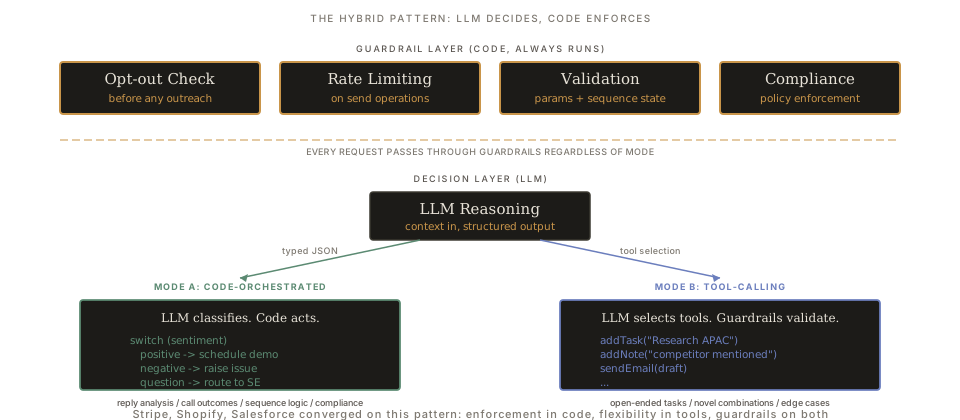
Code-Orchestrated Agents vs. Tool-Calling: The Architecture Decision That Matters Most
Stripe, Shopify, and Salesforce all converged on the same pattern: LLM decides, code executes. Here's the architectural reasoning, the trade-offs, and when tool-calling actually makes sense.
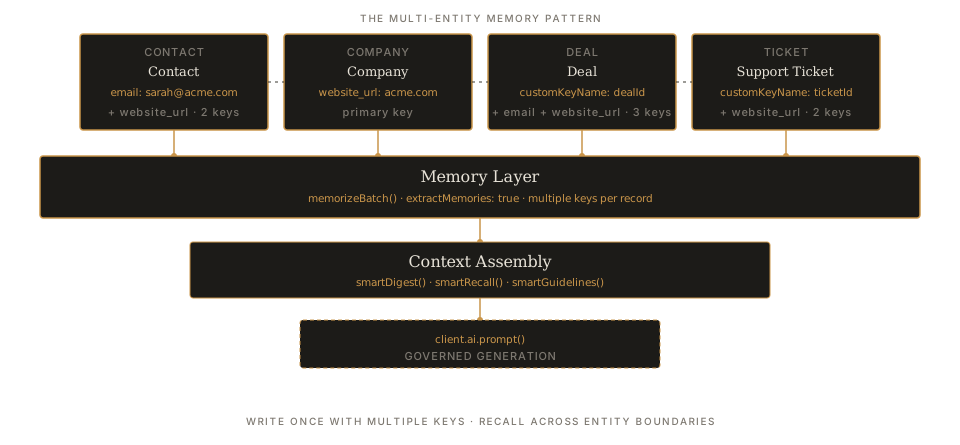
The Multi-Entity Memory Pattern
Most AI systems memorize contacts. The ones that work memorize contacts, their companies, their deals, and the relationships between all of them — then recall across entity boundaries at inference time.
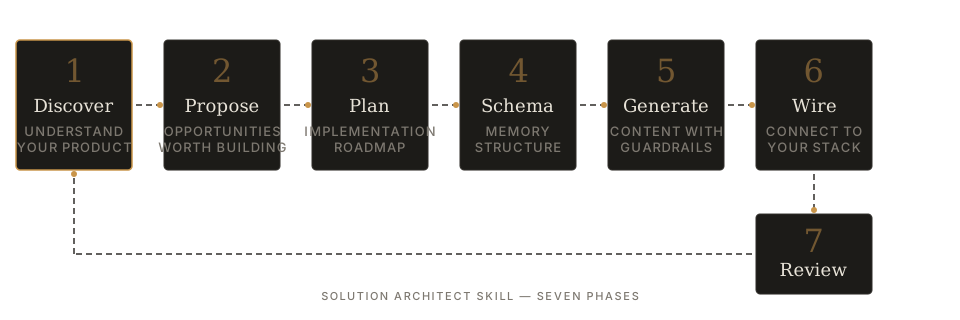
Encoding Solution Architecture Into an AI Skill
The early stages of AI implementation are mostly discovery — assembling scattered context into a coherent system design. We spent two years encoding that process. Here's what we found.
The Knowledge Problem in Enterprise AI: Why RAG Isn't Enough, and What We're Building Instead
Enterprises have thousands of documents AI agents should read. Context windows say they can't. RAG helps, but loses structure and intent. Here's how we're solving it.
AI AgentsRAGKnowledge ManagementContext EngineeringEnterprise AI17 min readBeyond Fact Count: Measuring What Actually Matters in Agent Memory Extraction
Memory extraction quality is not about how many facts you extract. It's about entity awareness, strategic depth, smart splitting, implied context, and cross-entity intelligence -- the levels that separate storage from understanding.
Agent MemoryMemory ExtractionEvaluationArchitectureLLM12 min readGuided Memory Extraction: Why Domain Expertise Belongs in Your Memory Pipeline
Why AI agents need extracted memories over raw content, and why guided extraction with entity awareness and domain expertise is what separates useful memory from noise.
Agent MemoryRAGMemory ExtractionArchitectureLLM15 min readOne Endpoint to Replace Ten: What We Learned Building a Unified Recall Interface
We had ten memory endpoints. Our agents only needed one. Here's what five rewrites of an intent classifier taught us about building a natural-language query layer for AI memory.
Agent MemoryArchitectureBuild LogPersonize11 min readThe AI Vendor Paradox: You Trust Them With Your Data But Can't Verify Anything
Enterprise AI requires handing sensitive data to platforms you can't inspect. The answer isn't better trust. It's better architecture, one where trust isn't required because verification is built in.
TrustTransparencyEnterprise AIData SovereigntyArchitecture17 min read4-Tier PII Redaction: How We Built Privacy Into the Memory Layer, Not Around It
AI memory systems ingest everything: emails, transcripts, documents. PII is embedded in all of it. We built redaction into the write path itself, not as a retrieval filter. Here's the architecture and why the distinction matters.
PIIPrivacyMemoryArchitectureEnterprise AI15 min readWhy the Next Wave of AI Winners Will Be Infrastructure Companies, Not Model Companies
The model layer is commoditizing at 280x in two years. The real defensibility is in the infrastructure between the model and the enterprise: memory, governance, deployment. That's the bet we're making.
AI InfrastructureEnterprise AIBusiness StrategyArchitecture12 min readLLM Function Calling in Production: What the Benchmarks Actually Say
The best models fail 30% of the time on complex tool-calling scenarios. Seven documented error patterns, infinite loop failures, and silent cascading errors. Here's what the data says before you ship function calling to production.
AI AgentsArchitectureAI Engineering10 min readAdversarial Governance Compliance — Our Methodology and What Near-Perfect Accuracy Tells Us
Delivering the right context to agents is one problem. Ensuring they respect what they must never do is another. Here's how we designed our adversarial governance experiment, what our results show, and why this work is never finished.
GovernanceComplianceEnterprise AIArchitecturePersonize9 min readDual Memory: Why You Need Both Free-Text Facts and Typed Properties
38% of valuable information no schema anticipated. 12% only usable with type enforcement. Neither modality alone captures the full picture, and both come from one extraction pass.
Agent MemorySchemaArchitectureGoverned MemoryPersonize11 min readThe Four-Layer Architecture Behind Governed Memory
Dual memory, governance routing, reflection-bounded retrieval, and schema lifecycle — the architecture we built when RAG wasn't enough.
ArchitectureGoverned MemoryAgent MemoryPersonize11 min read14 Agent Configs, 3 Teams, Zero Source of Truth
Sales embeds brand voice in a system prompt. Support copies compliance rules from a Notion doc. Marketing uses its own tone guidelines. When legal updates the data handling policy, nothing propagates.
GovernanceEnterprise AIMulti-Agent SystemsPersonize10 min readProgressive Context Delivery: How We Cut Token Usage 50% in Multi-Step Agents
When agents re-plan and act in loops, re-injecting the same governance context at every step is expensive and makes outputs worse. Here's the fix.
Agent MemoryGovernanceArchitectureEnterprise AIPersonize8 min readReflection-Bounded Retrieval: +25.7pp Completeness on Hard Queries
When the information an agent needs is scattered across 3–5 sources, a single retrieval pass misses most of it. Here's what actually works — and the surprising finding about what drives the gain.
Agent MemoryRetrievalArchitectureRAGPersonize8 min readWhy Schema-Enforced Memory Is the CRM Integration Layer AI Has Been Missing
Free-text memories can go into a prompt. They can't sync to Salesforce, filter by deal stage, or aggregate across 10,000 entities. That's the downstream dead end.
SchemaAgent MemoryCRMEnterprise AIPersonize10 min readSchemas Are Living Documents: The Closed-Loop Refinement Pipeline
Schemas age. Models get updated. Content types shift. New agent workflows produce data the schema wasn't designed for. Here's how to build a schema that keeps up.
SchemaGoverned MemoryArchitectureEnterprise AIPersonize9 min readSeven Memories Per Entity Is All You Need
Output quality saturates at roughly seven governed memories per entity. More context isn't better context — it's expensive noise.
Agent MemoryGoverned MemoryArchitecturePersonize8 min readThe $450K Email Your AI Sent Wrong
Your enrichment agent knows the CTO is evaluating three vendors. Your outbound agent sends a generic cold email anyway. This is how memory silos cost you deals.
Agent MemoryEnterprise AIMulti-Agent SystemsPersonize9 min readTwo-Phase Redaction: Scrubbing PII Before and After LLM Extraction
Most redaction pipelines scrub PII from the output. We scrub it before the LLM sees the content and again after extraction. Here's why both phases are necessary.
PrivacySecurityArchitectureEnterprise AIPersonize9 min read99.6% Fact Recall, 74.8% on LoCoMo — What the Numbers Actually Mean
Transparent breakdown of our experimental results: what we tested, what the numbers prove, what they don't, and why we benchmark against ourselves honestly.
Governed MemoryBenchmarksAgent MemoryPersonize9 min readZero Cross-Entity Leakage Across 3,800 Results
100 entities, overlapping names, same industry, similar roles — and zero actual memory bleed. Here's how entity isolation works when embeddings can't save you.
Entity IsolationAgent MemoryMulti-TenantArchitecturePersonize8 min readYour Agents Know Things. They Just Don't Tell Each Other.
Every workflow learns something. No workflow shares it. This is where organizational intelligence goes to die.
Agent MemoryMulti-Agent SystemsEnterprise AIAI ArchitectureKnowledge Sharing12 min readDogfooding governed memory: building smart notifications for our own product
I installed our own SDK as a customer with a standard API key. No internal shortcuts. This is what I built and what happened.
Build LogNotificationsSignalEntity Memory4 min readWhat's Relevant? What Do We Know? What Are the Rules?
Three questions that reveal whether your AI agents have what they need — or whether you're building on gaps.
Agent MemoryGovernanceRAGArchitecturePersonize13 min read7 Patterns for Building Governed AI Knowledge Bases
A response to The New Stack's excellent taxonomy. They got six right. Here's the pattern nobody's building yet, and a practical blueprint for how to build it.
Agent GovernanceKnowledge BasesArchitectureEnterprise AI11 min readAmazon, LinkedIn, and the Race to Build Agentic Knowledge Bases (Part 2)
Google, Microsoft, and Salesforce are each solving a piece of the agent governance puzzle. Here's what the pattern reveals — and the gap nobody has closed.
Agent GovernanceKnowledge BasesEnterprise AIGoogleMicrosoftSalesforce8 min readAmazon, LinkedIn, and the Race to Build Agentic Knowledge Bases (Part 1)
The biggest companies in tech are converging on the same conclusion: AI agents without organizational knowledge are a liability.
Agent GovernanceKnowledge BasesEnterprise AILinkedInAmazon6 min readWho's Actually in Charge of Your AI Agents?
Same company, same task, three different AI agents, three completely different answers. Your customers notice. Do you?
GovernanceEnterprise AIAgent Management8 min read3 Shortcomings of RAG as a Memory
The gap between 'stored' and 'remembered' is where agent quality lives.
RAGAgent MemoryArchitecture5 min readWhy Agents Fail Without Memory
If your AI agents forget everything between conversations, they're not agents — they're expensive autocomplete.
Agent MemoryEnterprise AIArchitecture9 min read